Adventures of Philip Marlowe
How It Came Together
Philip Marlowe arrived on radio in the summer of 1947 as a Tuesday-night replacement for Bob Hope on NBC, sponsored by Pepsodent. Van Heflin played the Los Angeles private detective in that first run, which lasted from June 17 through September 9 — thirteen weeks of half-hour episodes written by Milton Geiger, produced by Jim Fonda, and announced by Wendell Niles. Lyn Murray composed the music, and the premiere adapted Chandler's 1938 short story "Red Wind." It was a respectable summer stint, but what's most revealing about that NBC run comes from a photograph taken in 1947: Raymond Chandler, the novelist whose creation Marlowe was, standing alongside Heflin and Fonda and looking, by all accounts, unhappy about it. He was already putting his feelings into writing. In a letter to fellow crime novelist Erle Stanley Gardner, Chandler called the opening NBC episode "thoroughly flat." His involvement in the show, both that summer and during the later CBS years, was strictly ornamental — he received billing in the title but took no creative hand in either production.
One small wrinkle in that NBC premiere is worth noting: the producers deliberately excluded a live studio audience, unusual for radio, on the theory that an audience would detract from the mood. In its place, nineteen of Los Angeles's top detectives were seated in the studio for the broadcast. The New York Times reviewer found Heflin capable but felt the script leaned too heavily on straight narration at the dramatic moments, where action or dialogue would have served better. Only four episodes of the Heflin run are known to survive.
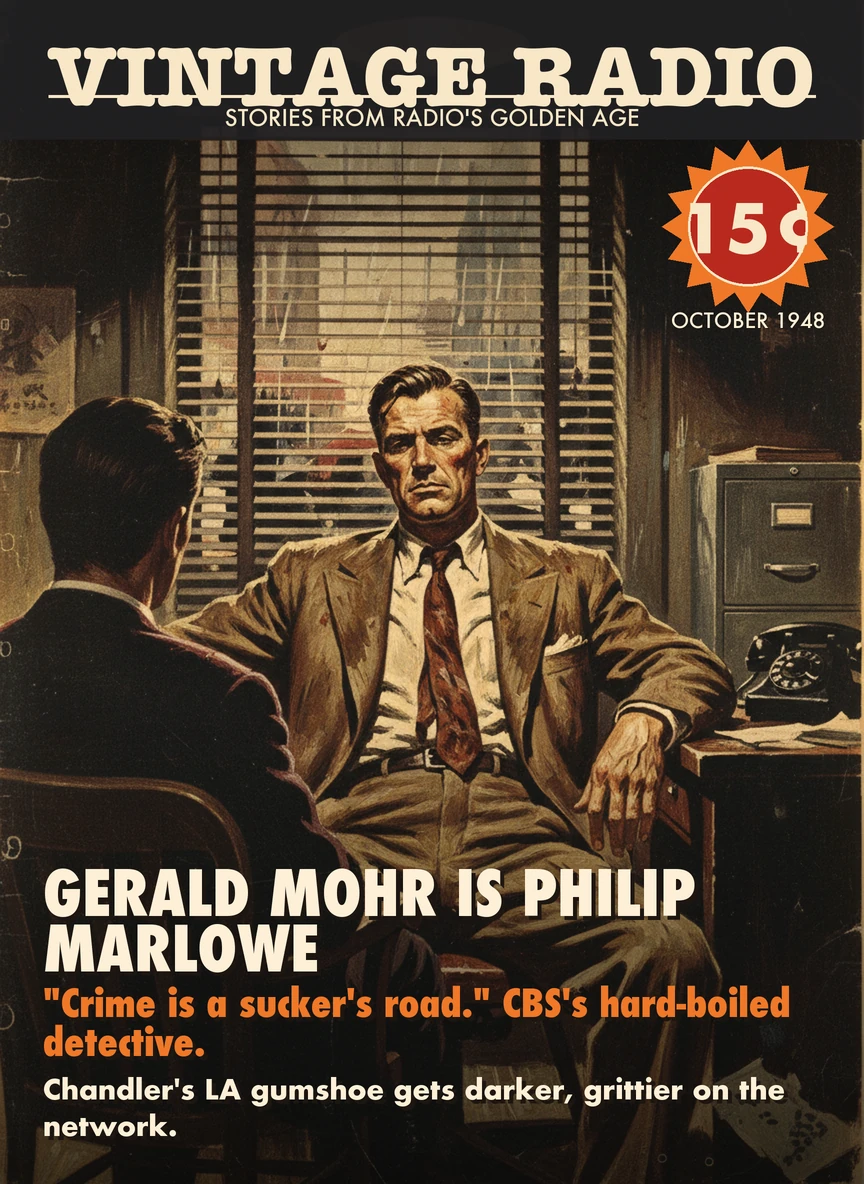
The CBS chapter began in September 1948, and it was a different animal. Gerald Mohr took over the role and played Marlowe through the end of the main CBS run on September 29, 1950, then returned for a shorter summer run from July 7 to September 15, 1951 — this time as a replacement for Hopalong Cassidy. Norman Macdonnell, who would go on to produce Gunsmoke, handled the CBS episodes as producer-director. The writing staff included Gene Levitt, Robert Mitchell, Mel Dinelli, and Kathleen Hite. Richard Aurandt composed the music (Ivan Ditmars scored the first two episodes), and Roy Rowan served as announcer. Even Chandler, who had dismissed the NBC version so sharply, found the CBS series somewhat more to his liking — he wrote to scripter Gene Levitt that Mohr's voice at least "packed personality."
The Voice in the Role
That question of personality was everything with this show, because the CBS version ran almost entirely on the strength of Gerald Mohr's voice. Mohr had one of the most distinctive voices on radio — a deep, unhurried baritone that fit the world-weary private eye better than almost any other casting could have. The CBS series traded in what one critic summed up as blood, guts, and thunder, driven by that bassy delivery. This was not a show that relied on wit or warmth. It wasn't aiming for the charm that The Adventures of Sam Spade carried, or the self-deprecating flippancy that Richard Diamond, Private Detective made its trademark. Marlowe was harder, grimmer, and Mohr played it straight. Reinehr and Swartz, in The A to Z of Old Time Radio, called it "a more hard-boiled program than many of the other private detective shows of the time, containing few quips or quaint characters."
The show's opening line set the tone from the first episode and never let up: "Get this and get it straight. Crime is a sucker's road, and those who travel it end up in the gutter, the prison, or an early grave." That kind of pronouncement, read each week in Mohr's voice over Aurandt's loud, stinging music, told the audience exactly what they were getting into. Episode titles like "The Hard Way Out" and "The Last Laugh" reinforced the point. There was no ambiguity about the genre, no lightness around the edges.
Mohr was so identified with the role that he played Marlowe in all but one of the CBS episodes — William Conrad filled in for "The Anniversary Gift" on April 11, 1950. By 1949, the show had the largest audience in radio, and CBS used that momentum to launch Yours Truly, Johnny Dollar a few months later. For the period the two ran concurrently, Dollar was considered the network's second-most-popular detective, after Marlowe.
The Company Around Mohr
One thing the CBS series had going for it beyond its lead was the supporting cast. Hollywood radio at this period had a deep pool of character talent, and Adventures of Philip Marlowe drew from it consistently. Edgar Barrier, Virginia Gregg, John Dehner, Lawrence Dobkin, Parley Baer, and Howard McNear all turned up in supporting roles — a roster of voices any radio listener of the era would have recognized immediately. Jeff Corey played the recurring role of Lieutenant Ybarra, giving the show a consistent police presence across the run. Gloria Biondell, Vivi Janiss, Lou Krugman, David Ellis, Wilms Herbert, Jack Moyles, Laurette Fillbrandt, Betty Lou Gerson, and Harry Bartell rounded out the ensemble that producers pulled from week to week.
Sound effects were in the hands of Cliff Thorsness, which mattered in a show this reliant on atmosphere. Hard-boiled radio lived and died on the clatter of a darkened office, the squeal of tires, the sound of a door coming open when it shouldn't. The technical craft behind the CBS run matched the ambition of the writing staff and the weight Mohr brought to the lead role.
Chandler at a Distance
Raymond Chandler's relationship with both versions of the show is worth understanding, because his name was attached to every episode without his fingerprints being on any of them. He created Marlowe in the novels — The Big Sleep, Farewell, My Lovely, and the rest — and the radio show traded heavily on that association. But Chandler neither wrote scripts nor guided stories for either network. According to Gene D. Phillips in Creatures of Darkness: Raymond Chandler, Detective Fiction, and Film Noir, Chandler had initially considered asking for script approval but ultimately decided to have no connection with the scripting at all. He "contented himself with the weekly royalties he received for the use of his character," Phillips writes, "while professing himself moderately pleased with Gerald Mohr's portrayal of Marlowe."
His private correspondence tells the fuller story. The NBC version left him cold enough to put his disappointment in a letter to Gardner. The CBS version earned a grudging acknowledgment, but only about Mohr's voice. The show borrowed his creation and his name; it built the rest itself, almost entirely from original scripts rather than adaptations of the novels. The September 26, 1948 CBS premiere of "Red Wind" is the only CBS episode known to have directly adapted an actual Chandler Marlowe story.
One CBS episode broke its own fourth wall in a way Chandler probably never saw coming. In "The Birds on the Wing," broadcast November 26, 1949, Marlowe opens by mentioning that he is reading "Chandler's latest The Little Sister," and the episode closes with him discovering Gracie Allen in his apartment, asking him to help her husband George Burns find a radio show on which he can sing. For a series whose default register was grim, it was a startling moment of self-awareness.
Ford Motors came on briefly as a CBS sponsor in 1950, followed by Wrigley's Gum, but for most of the run there was no sponsor at all, and the show moved across various days and time slots during its CBS years. It ended its main run in the fall of 1950, came back the following summer for the Hopalong Cassidy replacement stint, and closed out on September 15, 1951 — 114 CBS episodes in all.
What the Show Left Behind
Adventures of Philip Marlowe occupies an honest middle position in the history of radio crime drama. The CBS version had real strengths — a compelling lead performance, a capable supporting ensemble, sharp music, and a consistent tonal commitment to the hard-boiled world it was depicting. What it lacked was the distinguishing quality that lifted the best shows of its type above the pack. Sam Spade had wit. Richard Diamond had charm. Marlowe had Mohr's voice and a grim worldview, and for a certain kind of listener that was enough — enough, in 1949, to make it the most-listened-to show on the radio.
Gerald Mohr kept working steadily after the series ended — more than 500 radio plays across his career, seventy-some films, a hundred television appearances, including voice work as Reed Richards in the late-1960s Fantastic Four cartoon and Hal Jordan in two animated Superman series. He died of a heart attack in Stockholm in 1968, at fifty-four, while completing a TV pilot. Norman Macdonnell went on to co-create Gunsmoke with John Meston the following year and produce the television version after that. The show ran across parts of five years, crossed two networks, carried two actors in the lead role, and operated almost entirely independent of its source material's creator — a useful snapshot of how Hollywood translated hard-boiled fiction to radio in the late 1940s, not always flattering, occasionally impressive, and never quite what Raymond Chandler would have made of it himself.